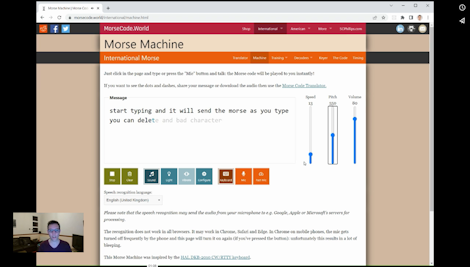
Just click in the page and type or press the "Mic" button and talk: the Morse code will be played to you instantly!
If you want to see the dots and dashes, share your message or save the audio then use the Morse Code Translator.
Stop the Morse playing.
Stop the Morse playing
Clear the message box.
Clear the message box
Turn the sound on and off.
Turn the sound on and off
Turn the light on and off.
Turn the light on and off
Turn vibration on and off.
Turn vibration on and off
Turn the microphone on and off for speech recognition.
Turn the microphone on and off for speech recognition
Transcribe speech before the end of a sentence.
Transcribe speech before the end of a sentence
Change the speed, pitch, volume and alphabet.
Change the speed, pitch, volume and alphabet
×
Please note that the speech recognition system may send the audio from your microphone to e.g. Google, Apple or Microsoft's servers for processing.
The speech recognition does not work in all browsers. It may work in Chrome, Safari and Edge. In Chrome on mobile phones, the mic gets turned off frequently by the phone and this page will turn it on again (if you've pressed the button): unfortunately this results in a lot of bleeping.
"CW Radio Tone" is the modern beep sound used in radio; "Telegraph Sounder" is the original clicky noise mostly used with American (not International) Morse.
Pitch in Hz. A high number makes a high pitched sound. 550 is a good value.
Volume from 0 to 100.
The character speed in words per minute, taking 'PARIS ' as the standard word.
The Farnsworth speed adjusts the space between letters and words, making it easier to learn Morse.
It can't be higher than the character speed.
The "Latin" alphabet is e.g. "ABC" (and includes accented characters). All the alphabets translate into dots and dashes with standard timing.
 │
│